Showing posts with label plastic. Show all posts
Showing posts with label plastic. Show all posts
Tuesday, September 7, 2010
The Majestic Plastic Bag
"...co-existing with billions of other petroleum species before breaking into ever-tinier plastic pieces."
Ugh.

Tuesday, August 10, 2010
More Bottled B*llsh*t
Found on the shelves of Marshalls - for a "bargain" price of course. I think my fave is the "Eternal" brand from New Zealand.


Wednesday, July 21, 2010
Using More Than Our Share
Annie Leonard's The Story of Stuff Project is getting lots of attention lately and we here at JustSaying LOVE IT. Sure, they're a little reminiscent of a UPS commercial and Annie works hard to speak in a language and tone understandable by all ages (AKA kids) but considering this blogger learned that plastic comes from oil via a children's book, we're tipping our hats to Annie and recommending her videos to our readers young and old. Even if you have read every book on our recommended list and every post to date, you will learn something from these videos and be moved to consume less (or feel like a total sucker). Check it out:
Tuesday, June 29, 2010
Pollution is Not Sexy
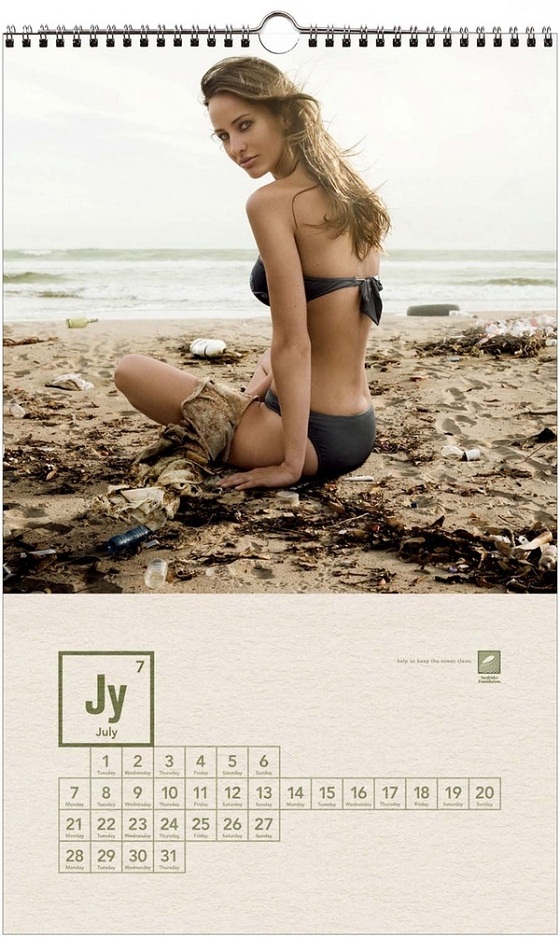
The National Surfrider Foundation commissioned a mock swimsuit calendar to remind everyone that sexy photo shoots on the beach will be a thing of the past if we don't clean up our act. I think they're talking to you, BP. Just saying. What do y'all think?
Thursday, May 27, 2010
Phthalates
Apologies for not alerting everyone to the episode of 60 Minutes that discussed these chemicals on Sunday night. Watch it here:
Monday, March 22, 2010
Love Little Green Books
 I had the pleasure of gifting and reading The Adventures of a Plastic Bottle to my little niece over the weekend and let me tell you, folks: it is adorably educational. The story about recycling follows the bottle from his beginnings as a blob of crude oil, through polymerization, construction, use, reuse, recycling and to his final form (spoiler alert) as a fleece sweatshirt. I mean, seriously... what's cuter than a spirited plastic bottle with googley eyes teaching our littlest generation important lessons about the processes that have become a huge part of our existence?
As you would expect, the books are printed on recycled paper and The Adventures of a Plastic Bottle is one of many in Simon & Schuster's Little Green Books series.
Other titles include:

Wednesday, November 11, 2009
Polluted Pacific
After a loyal reader pointed me towards a recent NY Times article about the island-sized patches of garbage afloat in the Pacific Ocean, I realized that I must not have given this topic enough attention when I was reading Thomas Kostigen's chapter "Where the Currents Take Our Trash" in his book You Are Here this past spring.
We're talking about huge islands of trash floating in remote areas of our oceans, folks. Here's a sampling of what these toxic whirlpools consist of (some still in their original shapes and form, others broken down into tiny, confetti-seized pieces that are gobbles up by marine life):
 Light bulbs, Tooth brushes, Plastic water bottles and caps, Glass, Pill bottles, Buoys and fish nets (more on this momentarily), Traffic cones, Plastic bags, Tires, Disposable lighters, Paper, Oil and oil cartons, Wood, Rope, Toys...
The patch Lindsey Hoshaw explored for the Times is about 1,000 miles east of Hawaii and is said to be doubling in size every decade. It is one of five ocean areas where heavy currents and slack winds keep the trash swirling in a giant vortex known to experts as a gyre. The impact of these patches on marine life is tremendous. There is a passage from a portion of Kostigen's book looking at the growing number of animals endangered by ocean debris that really hits it home:
"[Dr. Marcus Eriksen, director of research and education aboard the Charles Moore's Alguita vessel that discovered the Eastern Garbage Patch] spent time on Midway Island examining the effect of trash on albatross. 'I found birds with syringes sticking out of their stomachs and toothbrushes caught in their mouths,' Marcus says. He explains that albatross have two stomachs: one where they store food to feed their young and another where they digest food for themselves; plastic filled both. When he arrived on Midway he was shown a series of Laysan albatross skeletons. 'Every single one had plastic in it. Every single one.'"
Scientists have identified more than 250 species known to have been injured or killed by this ocean debris and bear in mind: this is only one aspect of the problem. These dangers eventually make their way to us.
Let's start at the bottom. Plankton is the base of the marine food chain. The amount of plastic fragments in the central Pacific outweigh zooplankton sixfold. Zooplankton are non-selective feeders and ingest anything small enough which is inevitably plastic. Then marine mammals feed on zooplankton and so forth up the chain. Our fate and the oceans' are certainly looking more and more parallel. I'll let Hoshaw take it from here:
"PCBs, DDT and other toxic chemicals cannot dissolve in water, but the plastic absorbs them like a sponge. Fish that feed on plankton ingest the tiny plastic particles. Scientists from the Algalita Marine Research Foundation say that fish tissues contain some of the same chemicals as the plastic. The scientists speculate that toxic chemicals are leaching into fish tissue from the plastic they eat.
The researchers say that when a predator — a larger fish or a person — eats the fish that eats the plastic, that predator may be transferring toxins to its own tissues, and in greater concentrations since toxins from multiple food sources can accumulate in the body."
If you can't picture it from words alone, I urge you to view the collection of photographs in this slide show from Hoshaw's visit to the patch with Charles Moore, the captain who came upon the patch in 1997 during the Transpacific Yacht Race and has dedicated his vessel to researching it since 1999. Keep in mind, the pictured patch is said to pale in comparison to the Western Garbage Patch, just south of Japan, that captures trash from Asia, Russia, India and the Malaysian Peninsula.
We're all in this together. What the what are we going to do!?
Thursday, April 23, 2009
transparency
 Rachel Leven wrote a great investigative post for Slate, Green Eggs and Plastic, regarding the reasoning behind the use of plastic in the organic food market. From the article:
...And the ultimate question: Why does organic food involve so much plastic packaging? Doesn't that defeat the purpose? Yes, it does...
...Enter the plastic. Thanks to the USDA's seal, hippies and Luddites were no longer the major consumers of organic food. The game had changed. Organic shoppers of the mid-millennium now cared less about the sustainability and ethical concerns surrounding organics. Instead, they were concerned with the quality, healthfulness, and (unproven) nutritional benefit. Organics also entered the market as luxury (read: expensive) items, which meant consumers expected more convenience. In this environment, the biggest advantage of plastic cartons was literally clear. See-through packaging revolutionized the egg industry by eliminating the tiring task of opening the carton's lid to check the eggs for quality. The result was comforting and easy transparency, promising a superior product. The plastic carton itself is neither better nor worse for the egg...
Obviously the organic trade isn't the only agricultural sector utilizing plastic packaging and there are plenty of perks to doing so - like guarding against bugs, oxygen, and extending shelf life therefore enabling mass consumption - but at some point branding comes into play and that is why I say: Question everything, folks. Are beautifully packaged "organic" eggs from across the country in any way better than those from the local farmer who can't afford the organic certification label? Probably not. Think globally. Act locally.
Subscribe to:
Posts (Atom)