Showing posts with label red meat. Show all posts

Friday, January 20, 2012

Decline in U.S. Meat Consumption


After 70 years of steady incline, American meat consumption is on the decline. Considering we account for less than one twentieth of the world population yet have been responsible for one sixth of the world meat consumption (and therefore accompanying environmental implications), I think it is safe to say this is pretty good news.

Last week, Mark Bittman wrote a great piece about the swirl of discussions aiming to pinpoint reasons for the decline including: Growing exports making less meat available to Americans, ethanol and the rising cost of feed, federal government "waging war" on meat consumption, and the most optimistic reason (that I'm rooting for) conscious consumer decisions.

This week, Brent Kim put together an incredibly informative and thoughtful blog post about the USDA estimates that says everything I would say and more so I highly recommend reading heading over to the Center for a Livable Future blog and spending some time with his post (find it here).

Sunday, January 2, 2011

2011 Welcomes a New Type of Reality TV: 'Kill It, Cook It, Eat It'


On Tuesday, January 11th 2011 at 10pm EST Current TV will begin airing episodes of Kill It, Cook It, Eat It, a television series that follows a diverse group of participants as they "procure their main course the old-fashioned way: by hunting and killing their chosen prey, butchering it in the slaughterhouse, helping to prepare it in the kitchen, and ultimately sampling it at the dinner table."

A few weeks ago, when a classmate of mine invited me to an exceptional local turkey farm to procure a main Thanksgiving course the old-fashioned way, I got to thinking whether or not I could go through with the deed. After about three seconds of thinking I said, "Nope. No thank you, but I admire you for doing so" and went along my merry meat-free way. I have been considering the topic throughout the holiday season and have decided to watch this series because I believe it will offer a hint of the experience without the anti-feedlot activist spin and at enough distance that I can still sleep at night.

Like so many increasingly conscious eaters, I have been on the fence between strict vegetarian and polite house guest for some time now and wonder if this series, likely filled with the painful audiovisuals books on the topic spare, will push me to take a stronger stance.

Tuesday, August 10, 2010

Meatless Monday


A reader and friend alerted me to a great story from NPR about how folks are re-framing Meatless Monday to gain followers in the younger demographics who aren't necessarily thinking about their blood pressure and cholestoral. Read the article or listen to founder of Meatless Monday, Sid Lerner, talking with NPR here.

I know what you're thinking: "What does this have to do with Water Month here on JustSaying?" The answer is: a ton. From the article:

"One of the biggest advantages of cutting back on meat consumption is the reduction in the water demand," says environmentalist Peter Gleick of the Pacific Institute [and author of Bottled & Sold].

Gleick says people are shocked when they realize how much water it takes to grow the grain needed to feed cows to produce 1 ton of beef.

"It takes 140,000 bathtubs full of water — that's millions and millions of gallons," Gleick says. And it's not something people consider when they try to imagine their "water footprint."

Monday, July 12, 2010

Foot-Long Cheeseburger

Apparently a fast food joint out on the left coast called Carl's Jr is testing out this foot long cheeseburger - which is really just several cheeseburgers on a sub roll - to see if it should become a regular part of their menu. Is it just me or does it seem like there is a competition on which chain can win the title of unhealthiest sandwich ever?

Saturday, July 3, 2010

The CAFO Reader

I know it's 4th of July weekend and everyone wants to have their barbecue and ignore its environmental cost too, but we've found a new book for the summer reading list and it's all about CAFOs. The who's who of the sustainable food movement got together and penned a fearless collection of essays on factory farming for The Cafo Reader: The Tragedy of Industrial Animal Factories. Favorite of ours, Anna Lappé, contributed a chapter on the link between livestock and the climate crisis. Michael Pollan and Eric Schlosser contributed as well.

The University of California Press summarizes:

These essays analyze and vividly depict the devastating impacts and current conditions in and around factory farms. The collection also provides a compelling vision of  “putting the CAFO out to pasture,” in which food systems become more healthy, humane, and sustainable. The CAFO Reader will quickly become an invaluable educational resource in the battle to reform the tragic state of industrial livestock production. It will also inform and influence the growing public movement of activists, farmers, policy makers, and consumers who are aiming to make our food healthier for ourselves and the planet.

Word on the street is that a larger photographic volume fit for a coffee table will be out this fall.

Wednesday, June 9, 2010

Seriously??

Bloom, a grocery store in the Food Lion family, unveiled one of the nation's first scented billboards last week in Mooresville, North Carolina. The sign emits the "scent of freshly grilled steak" most strongly in the morning between 7am and 10am and in the evenings from 4pm to 7pm. Watch the local news report here.

Tuesday, June 8, 2010

Heaven on earth with an onion slice?


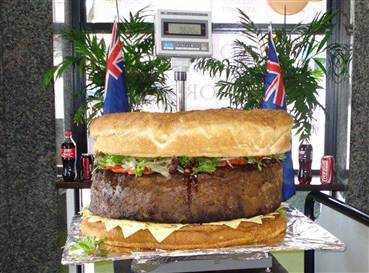
Congratulations to the idiots behind this record-breaking, 198-pound, vomit-inducing burger. Gross. Four men in an Australian cafe spent 12 hours cooking and flipping the 178-pound patty and managed to beat the previous record, 185 pounds, set in Michigan. Read all the juicy details here. Eww. Ick. Bleh.

The burger will be on the menu at the cafe for the next year (in order to meet the conditions required by the Guinness World Record) at a bargain price of $1,220 American dollars.

Monday, April 12, 2010

New Studies

Making sustainable choices just got even more complicated. Slate's Green Lantern dedicated a column to three new studies: One suggesting meat and dairy consumption plays a smaller role in greenhouse emissions than... gulp... transportation; Another points out that our country's carbon footprint only seems smaller because we outsource our greenhouse emissions; And the last brings some good news about how impactual certain personal green choices can be. Read more here.

So continue to keep your vehicles well-maintained, choose local foods when possible, switch to florescent bulbs, and use electricity sparingly but perhaps JustSaying shouldn't hassle folks about their occasional steaks until she is driving a hybrid, huh? 

Wednesday, June 17, 2009

Fun Factoid

If 10,000 people hop on the Meatless Monday train and replace red meat with vegetarian fare that one day per week, in a year we'd avert the emissions produced by driving a car around the earth (equator) 464 times. Just saying.

(Courtesy of Ideal Bite)

Wednesday, April 29, 2009

Case against red meat continues to build

The NY Times published an excellent article about the results of the decade-long study directed by Rashmi Sinha, a nutritional epidemiologist at the National Cancer Institute, on the effects of red meat consumption, published in the March 23 issue of The Archives of Internal Medicine. The bottom line: those who consumed the most red and processed meat were likely to suffer from heart disease and cancer and die sooner than people who consumed much smaller amounts of these foods. Epidemiologist, Dr. Barry Popkin, weighs in on the personal and environmental risks:

"...people should eat a hamburger only once or twice a week instead of every day, a small steak once a week instead of every other day, and a hot dog every month and a half instead of once a week... Anyone who worries about global well-being has yet another reason to consume less red meat. Dr. Popkin said that a reduced dependence on livestock for food could help to save the planet from the ravaging effects of environmental pollution, global warming and the depletion of potable water... “In the United States,” Dr. Popkin wrote, “livestock production accounts for 55 percent of the erosion process, 37 percent of pesticides applied, 50 percent of antibiotics consumed, and a third of total discharge of nitrogen and phosphorus to surface water.”

Learn more here and here.